Smart Irrigation Systems for Farms, Pasture & Greenhouses
Soil moisture sensing, automated valves and pumps, and tank and flow monitoring, so water is applied when it is needed and problems are caught early.
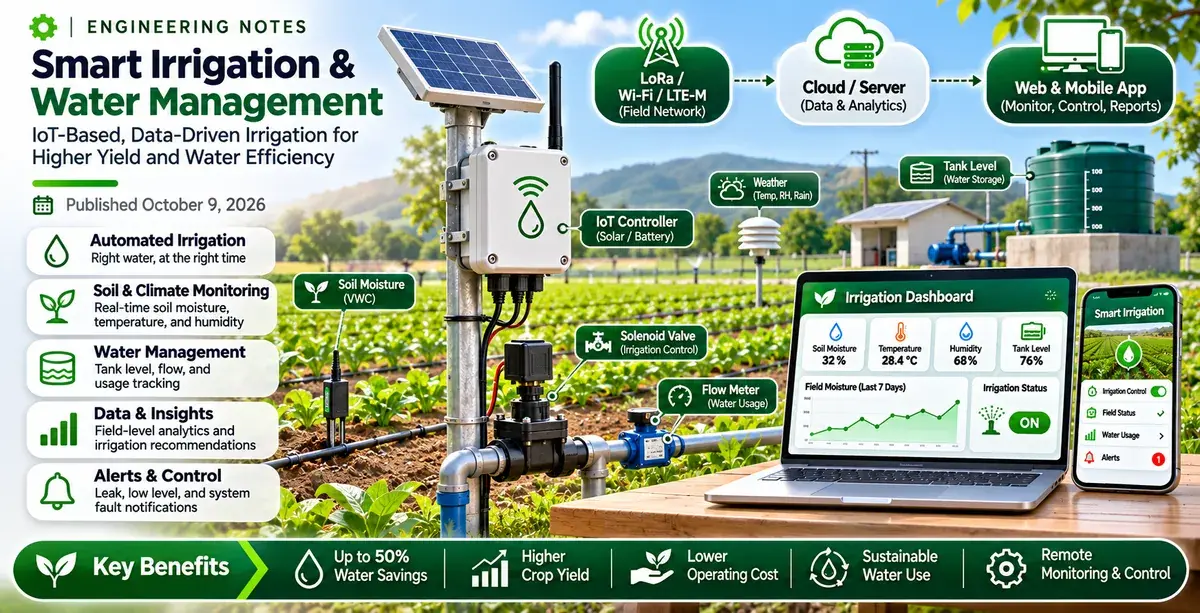
What the system can measure and control
What a Smart Irrigation System Does
Timers water on a schedule whether the ground needs it or not. A smart irrigation system uses measurements to decide when and how much to water, and warns you when something goes wrong.
Soil moisture sensing
Probes at root depth show how much water is actually available to crops or pasture, so irrigation starts when soil dries out rather than at a fixed time.
Automated valves & pumps
Solenoid valves and pump controllers switch zones on and off by soil moisture, schedule or remote command, with a manual override.
Weather-aware scheduling
Rainfall sensors and forecasts let the system skip or shorten cycles when rain is expected or has already fallen.
Tank & reservoir levels
Level sensors in tanks, dams and reservoirs show how much water is left and stop pumps before they run dry.
Flow & leak detection
Flow meters compare expected and actual flow per zone, flagging burst pipes, blocked lines and valves that fail to open or close.
Off-grid operation
Solar-powered controllers and low-power wireless nodes for remote fields with no mains power or cabling.
How a Smart Irrigation System Is Designed
Field size, water source, crop and power supply all shape an irrigation design. These are the parts we work through with you before hardware is built.
Sensor nodes
Soil moisture, rain, level and flow sensors on low-power wireless nodes, built to survive mud, sun and frost.
Valve & pump controllers
Controllers for solenoid valves, pumps and existing irrigation equipment, with local rules that keep working offline.
Field connectivity
LoRaWAN for wide areas, or cellular for isolated sites, chosen by field size, terrain and distance to the gateway.
Power design
Battery and solar sizing so field nodes and controllers run through cloudy weeks without maintenance.
Dashboard & alerts
Soil moisture trends, water use per zone and alerts for leaks, low tanks and failed valves, on phone or web.
Engineering trade-offs
Number of probes vs. cost
Soil varies across a field. More probes give a better picture but cost more; we place them where soil and crop differences matter most.
Automatic vs. advisory
Some farms want valves to switch automatically; others prefer alerts and a recommendation. Both can be built, with manual control kept.
Solar vs. battery only
Solar adds cost and size but removes battery changes for valve controllers and pumps, which draw more power than sensors.
Retrofit vs. new system
Adding sensors and control to existing pumps and valves is cheaper; a new layout can be designed for automation from the start.
Information that helps us scope a project
- Crops or pasture, field sizes and number of zones
- Water source: well, tank, reservoir or mains
- Existing pumps, valves and controllers
- Power available at pumps and in the field
- Distances between fields and to the farm buildings
- Whether you want automatic control or alerts only
Related pages and articles
This section describes custom engineering services. Reference designs on our Projects page are concepts and prototypes, not products available to purchase.
Common questions
What is a smart irrigation system?
A smart irrigation system uses soil moisture sensors, weather data and flow and level sensors to decide when and how much to water, controls valves and pumps automatically or by remote command, and alerts you to leaks or faults.
How do soil moisture sensors control irrigation?
Probes at root depth report how wet the soil is. When moisture drops below a level set for the crop and soil type, the controller opens the valve for that zone, and closes it when the target is reached or a time limit passes.
Can it work on fields without power or internet?
Yes. Field nodes and valve controllers can run on batteries and solar, and connect over LoRaWAN to a gateway near the farm buildings or over cellular where there is no gateway.
Can you add sensors to our existing irrigation?
Often, yes. Many existing pumps and valves can be controlled through relays or their own controllers. We check compatibility during scoping.
Does smart irrigation also work for livestock water?
Yes. The same tank-level, flow and pump control is used for livestock water supply, with alerts when troughs or tanks run low.
Need a Custom Smart Irrigation System?
We'll design sensors, controllers and connectivity around your fields, water source and power supply.