Animal Health Monitoring Devices for Livestock & Pets
Wearable and installed sensors that track activity, rest, temperature and behaviour, so changes that can signal illness, heat or injury are noticed earlier.
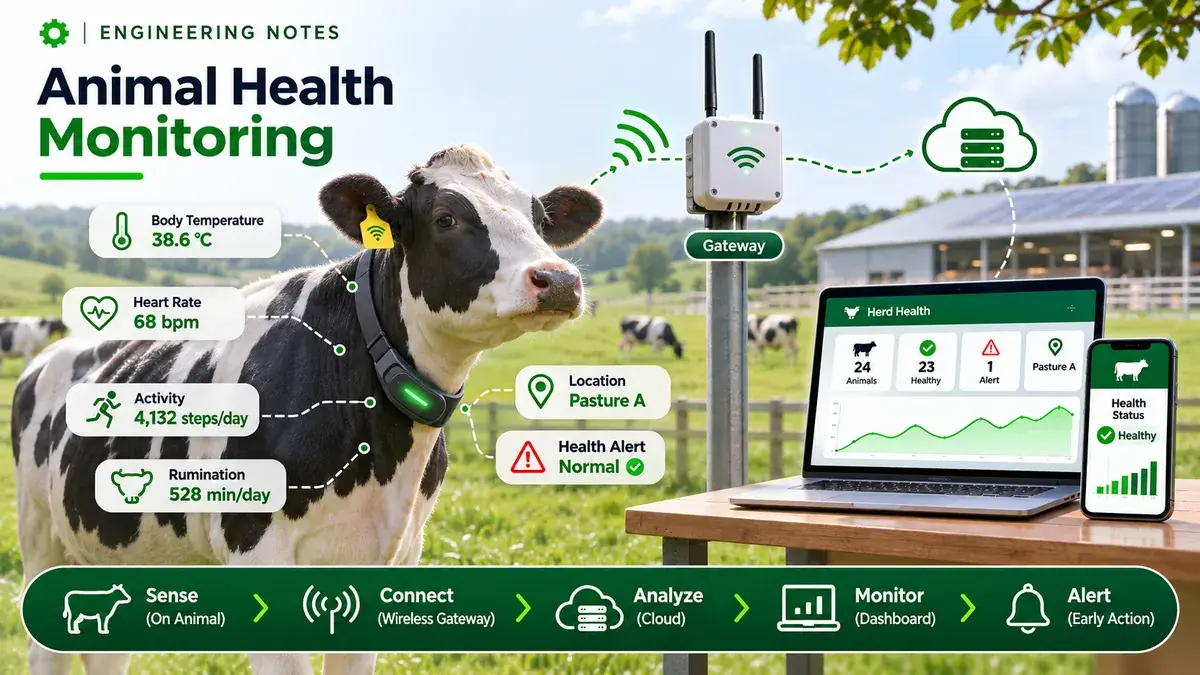
Signals we can measure
Early Signs, Not Just Data
Health monitoring is useful when it turns readings into early warnings. Sudden changes from an animal's own normal pattern often matter more than any single value.
Activity & rest
Accelerometers in collars, ear tags or leg bands show how much an animal moves and lies down. A sharp drop can signal lameness or illness; a rise can signal heat in cattle.
Rumination & feeding
Time spent chewing and eating is one of the earliest indicators of digestive or metabolic problems in cattle, often before visible symptoms.
Temperature
Skin, ear or bolus temperature trends help flag fever and heat stress. Placement matters: skin readings follow the weather, so trends are compared per animal.
Water & feed visits
Sensors at troughs and feeders, combined with RFID, show which animals are eating and drinking less than usual.
Pets & companion animals
Activity, sleep and scratching patterns from lightweight wearables help owners and vets see gradual changes in a pet's health.
Alerts & trends
Rules and baselines per animal turn raw readings into a short list of animals to check today, with history for the vet.
How a Health Monitoring Device Is Developed
Health devices have to be small, comfortable and run for months on a battery, while measuring reliably on a moving animal. These are the parts we scope with you.
Wearable hardware
Collars, ear tags, leg bands or harness devices with motion and temperature sensors, sized for the animal and its environment.
On-device processing
Firmware that classifies activity, rest and rumination on the device, so only summaries are sent and battery life is preserved.
Connectivity
BLE, LoRaWAN or LTE-M depending on whether animals are in a barn, on pasture or at home.
Baselines & alerts
Per-animal baselines and alert rules, developed with your vets or domain experts, sent to a dashboard or app.
Field validation
Prototype devices tested on animals against observations or reference measurements before production.
Engineering trade-offs
Sampling rate vs. battery life
Detecting rumination or gait needs fast motion sampling, which costs power. Processing on the device keeps radio use low.
Device size vs. capacity
A smaller tag is more comfortable but holds a smaller battery. Animal size and how often the battery can be changed set the limit.
Measurement site vs. accuracy
Ear, neck, leg and internal measurements each see different signals. The right site depends on what you need to detect.
Alert sensitivity vs. false alarms
Too sensitive and staff stop trusting alerts; too strict and real problems are missed. Thresholds are tuned during validation.
Information that helps us scope a project
- Species, age and housing or pasture conditions
- The health conditions or events you want to detect
- Where on the animal a device can be worn
- Required battery life and acceptable device size
- Existing herd management or vet software
- Target volume and timeline
This section describes custom engineering services. Health monitoring devices support, but do not replace, veterinary diagnosis. Reference designs on our Projects page are concepts and prototypes, not products available to purchase.
Common questions
What is animal health monitoring?
Animal health monitoring uses sensors worn by or installed near animals to track signals such as activity, rest, rumination, temperature and feeding, and to alert you when an animal's pattern changes in a way that can indicate illness, heat or injury.
Can sensors detect illness in cattle?
Sensors can't diagnose disease, but changes in rumination, activity, lying time and temperature often appear before visible symptoms. Monitoring flags which animals to check, so a vet or stockperson can act sooner.
How long do the batteries last?
It depends on the sensors, how often data is processed and sent, and the battery size. Processing on the device and sending summaries instead of raw data is the main way we extend battery life.
Do you build health devices for pets as well as livestock?
Yes. We design lightweight wearables for dogs and cats as well as collars, ear tags and leg bands for cattle, sheep, goats and horses.
Can the data connect to our existing herd software?
Often, yes. We can send data to an existing platform through an API, or build a simple dashboard for the project.
Need a Custom Animal Health Device?
We'll design sensors, firmware and alerts around your animals, environment and the conditions you need to detect.