Planning a LoRaWAN Network for a Farm: Gateways, Coverage and Battery Life
Published
LoRaWAN is a natural fit for agriculture: small battery-powered sensors, a few bytes per message, long distances and no Wi-Fi in the fields. Whether a farm network works well, though, depends far more on planning than on the sensors themselves.
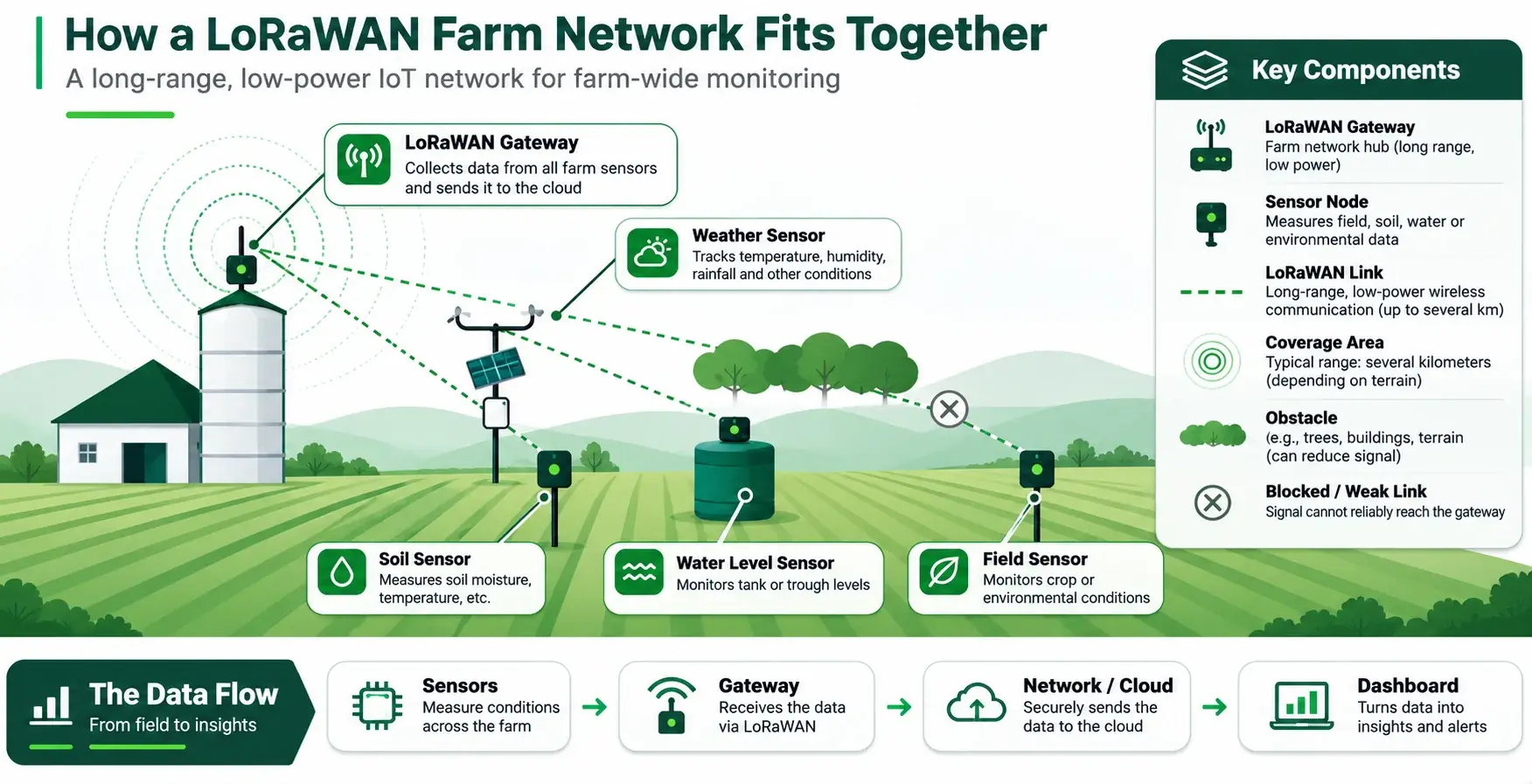
How a LoRaWAN farm network fits together
A LoRaWAN network has four parts. End devices — soil moisture probes, water level sensors, weather stations, trackers — send short radio messages. Gateways receive them and forward them over an internet connection. A network server removes duplicates, manages security keys and adapts each device's data rate. An application stores the data and raises alerts. Devices aren't paired to a single gateway: any gateway in range can receive a message, which is what makes adding a second gateway such an effective way to fill gaps.
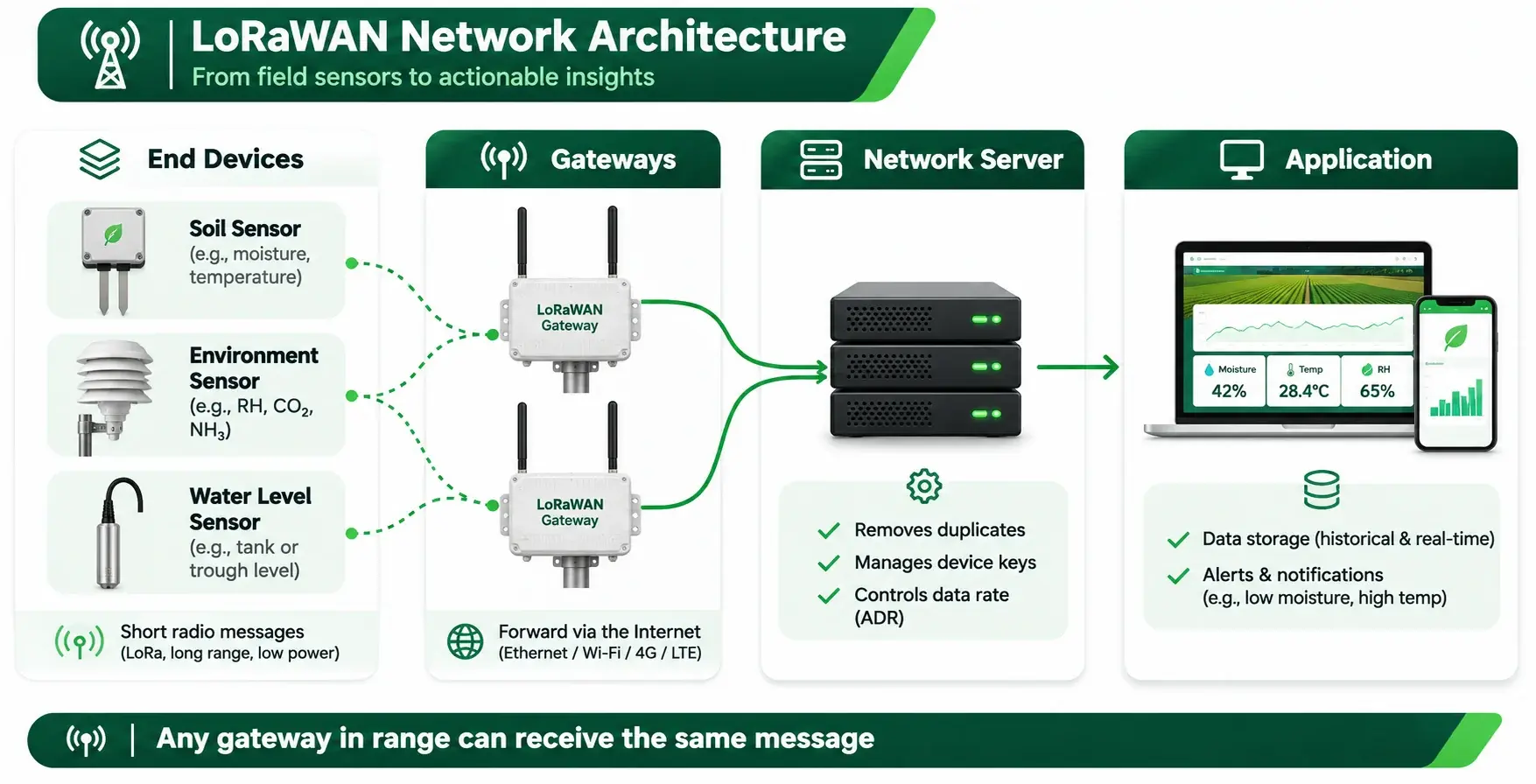
Realistic range: why the brochure number rarely applies
Range figures for rural LoRaWAN vary widely between sources — from a few kilometres to well over ten. Both can be true. Range depends mainly on:
- Gateway antenna height. This is usually the biggest single factor. A gateway on a tall mast or silo sees far more of the farm than one inside the farm office.
- Terrain and obstacles. Hills, tree lines and buildings block or weaken the signal. Radio needs a clear path with some space around it (the Fresnel zone), not just a visual line of sight.
- Device antenna and position. A sensor at ground level, inside a metal tank or in tall crops loses a lot of signal compared with one on a post.
- Spreading factor. Higher spreading factors reach further but keep the radio on much longer for each message, which costs battery and airtime.
The reliable way to plan is a site survey: put a temporary gateway where you intend to mount it, walk or drive the farm with a field tester or test device, and record signal strength at the actual sensor locations. An afternoon of testing replaces a lot of guesswork.
Regional frequency plans: EU868 and US915
LoRaWAN uses licence-free radio bands, and the rules differ by region. Devices and gateways must match the regional plan where they are installed.
Europe and the UK: EU868
In Germany, Austria, France, the UK and the rest of Europe, LoRaWAN operates around 868 MHz. Most channels are subject to a duty-cycle limit — on the main sub-bands, a device may transmit for only 1% of the time. For a sensor sending a reading every 15 minutes this is no problem; for a device trying to send large amounts of data at a high spreading factor it is a hard limit.
United States: US915
In the US, LoRaWAN operates in the 902–928 MHz band. There is no duty cycle in the same form, but a dwell-time limit of 400 ms per transmission means the slowest, longest-range data rates used in Europe are not available for standard uplinks. US915 also has many more channels than a typical gateway listens to, so devices and gateways must be configured for the same sub-band — a common cause of “the sensor works on the bench but never joins”.
Gateway placement, power and backhaul
- Height and position: as high and as central as practical — a mast, silo or barn roof — with an outdoor-rated antenna and short, low-loss cable.
- Power: gateways run continuously. Mains power is simplest; a remote mast needs a solar panel and battery sized for the darkest weeks of the year.
- Backhaul: the gateway needs its own internet connection — Ethernet from the farm office, a cellular modem, or a point-to-point wireless link. Without backhaul, it collects data no one can see.
- Lightning and weather: an outdoor antenna on a tall structure needs surge protection and proper grounding.
Public, community or private network?
Public operator networks exist in some regions, but rural coverage is often incomplete — check the specific farm, not the coverage map. Community networks, such as The Things Network, are free to use but come with a fair-use policy that limits airtime (for example, 30 seconds of uplink airtime per device per day) and offer no service guarantees. A private network — your own gateways and a hosted or self-run network server — gives full control over coverage and data, at the cost of owning the infrastructure. For most farms with business-critical alerts, a private network or a hybrid with your own gateways is the more dependable choice.
Battery life of LoRaWAN sensor nodes
Multi-year battery life is achievable — but only for the right combination of reporting interval, spreading factor and sensor. Typical drivers are:
- How often the device transmits, and how long each message is on air.
- The sensor itself — some, such as gas sensors or ultrasonic level sensors, need significant power for each reading.
- Sleep current between readings, which dominates for devices that report rarely.
- Temperature: cold reduces usable battery capacity.
Primary lithium cells (such as Li-SOCl₂) are common for long-life nodes because of their low self-discharge.
Sensing is easy, control needs more thought
Most LoRaWAN devices are Class A: they only listen for a message from the network briefly after they transmit. That is ideal for battery sensors but means a command — open a valve, switch a pump — may wait until the device next reports. For control, use Class C devices (always listening, so normally mains-powered), keep safety-critical logic on the local controller, and always confirm that the action actually happened. LoRaWAN is a strong choice for monitoring; for fast control loops, a wired or local connection is often the better tool.
A planning checklist
- Map sensor locations and the reporting interval each one really needs.
- Pick candidate gateway sites with height, power and backhaul.
- Run a site survey at the actual sensor positions.
- Choose the network model: private, community, operator or hybrid.
- Check the regional plan (EU868 or US915) for every device and gateway.
- Size batteries from measured consumption, not datasheet best cases.
Frequently asked questions
How many LoRaWAN gateways does a farm need?
It depends on terrain far more than on area. One well-placed gateway on a tall structure can cover the core of many farms; hills, woodland and distant fields may need a second gateway or a mast. A site survey at the actual sensor locations is the only reliable way to decide — and because any gateway can receive any device, adding one later is straightforward.
How many sensors can one gateway handle?
A LoRaWAN gateway can receive messages from a large number of devices, and at typical farm reporting rates — one small message every few minutes to every hour — gateway capacity is rarely the limiting factor. Airtime is: devices using high spreading factors occupy the channel longer, so good coverage (allowing lower spreading factors) helps both battery life and capacity.
Can LoRaWAN carry images or video?
No. LoRaWAN is designed for small messages — typically tens of bytes. Camera traps, video and firmware images need a different link such as cellular or Wi-Fi. A common pattern is to use LoRaWAN for sensor data and alerts, and cellular for the few devices that need bandwidth.
Is LoRaWAN secure?
LoRaWAN encrypts traffic with AES-128 at two levels: one key protects the network layer and another protects the application payload end to end. In practice, security depends on key management — unique keys per device, keys that are not printed on labels or committed to code repositories, and a network server you trust.
Planning LoRaWAN sensors or gateways for a farm or a product? Get in touch — sensor nodes and network designs can be developed for your site and region. See also Farm Automation and Environmental Monitoring.