Livestock Monitoring Sensors: What Each Sensor Measures and How to Connect It
Published
A remote livestock monitoring system is only as useful as the sensors at its edge. Before choosing a platform or a network, it helps to be clear about what each type of sensor can and can't tell you — and what it costs in power and maintenance.
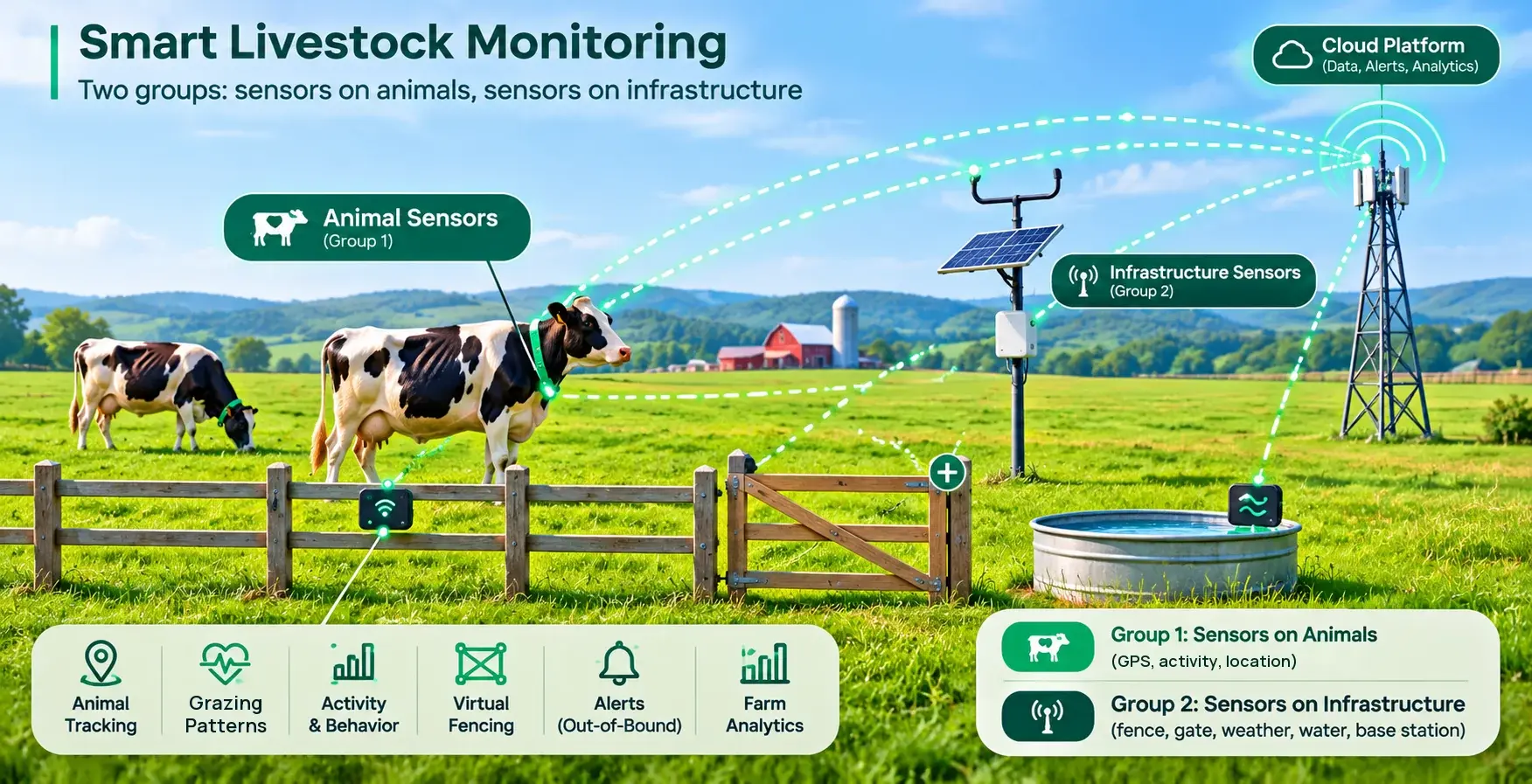
Two groups: sensors on animals, sensors on infrastructure
Livestock monitoring sensors fall into two groups. Animal-worn sensors — collars, ear tags, leg bands — tell you where animals are and how they are moving. Infrastructure sensors — on water troughs, tanks, gates, fences and weather masts — tell you whether the things animals depend on are working. Many problems on a cattle operation show up first in the infrastructure: a trough that stops refilling or an electric fence that loses voltage. Those sensors are often cheaper, easier to power and easier to maintain than anything worn by an animal, which makes them a good place to start.
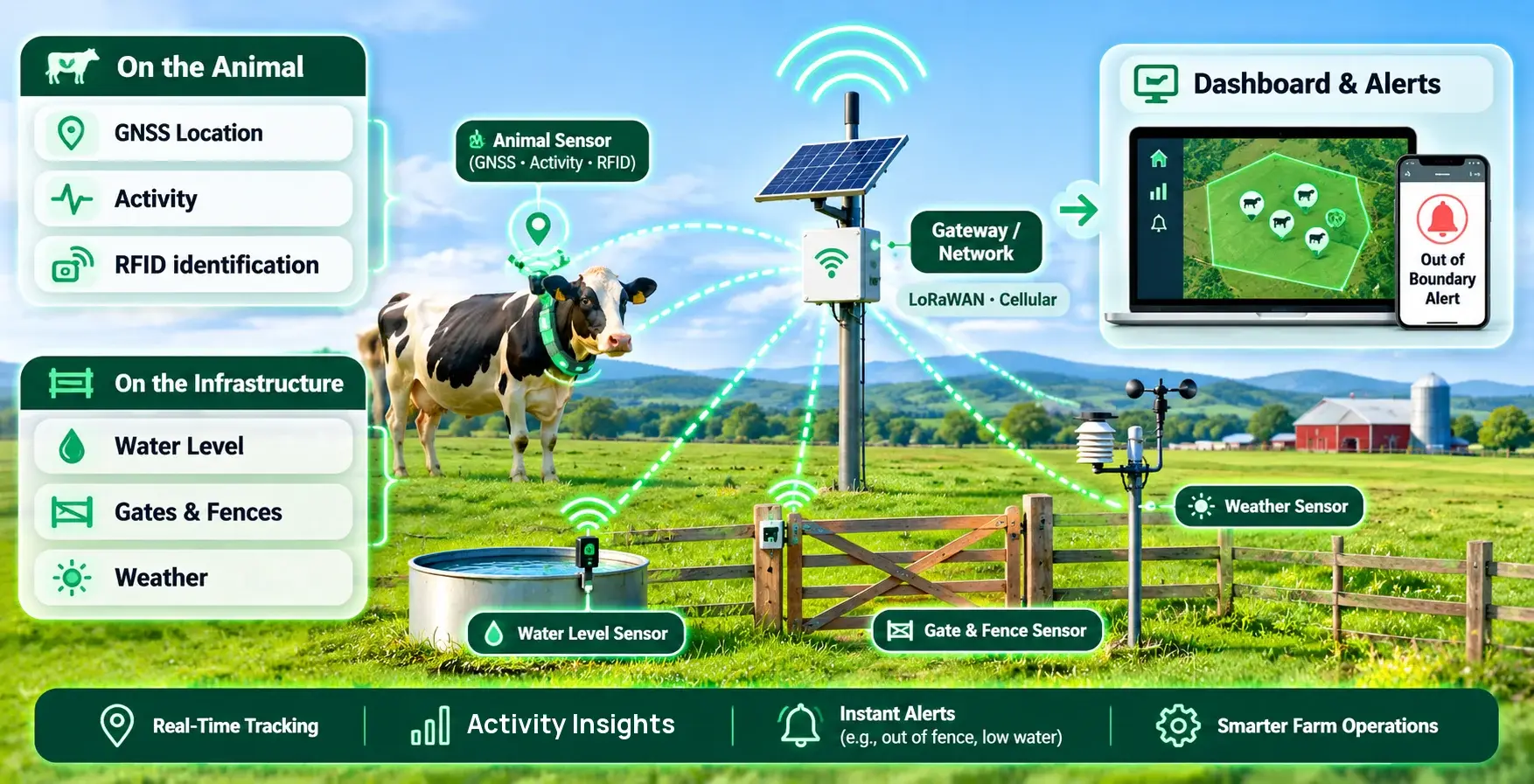
Animal-worn sensors
GPS / GNSS location
A GNSS receiver on a collar or tag reports position. It answers practical questions: where is the herd, has an animal left the property, which part of a pasture is being grazed. Accuracy under open sky is typically a few metres, worse under trees or in steep terrain. The receiver is also usually the biggest energy consumer on the device, so the reporting interval is the main lever on battery life — a fix every few hours lasts far longer than a fix every few minutes.
Accelerometers for activity
A three-axis accelerometer measures movement. With suitable firmware it can separate broad behaviours such as walking, standing and lying down, and show changes in daily activity patterns. Field studies of LoRaWAN cattle collars have shown clear day-and-night grazing patterns from this kind of data. Accelerometers use very little power, and they are also useful to the device itself: the firmware can skip a GNSS fix when the animal hasn't moved.
RFID identification
Low-frequency RFID ear tags (134.2 kHz, following the ISO 11784/11785 standards) are passive: they have no battery and are read when an animal passes a reader at a gate, race or scale. They don't report location on their own, but combined with a fixed reader they identify which animal was where — for example, at a water point or on a walk-over weighing platform.
Infrastructure sensors
Water level in troughs and tanks
Water is the most common reason for a daily drive around a ranch. Level sensors replace that check. Ultrasonic sensors measure distance to the water surface from above and don't touch the water, but foam, debris and condensation can affect them. Submersible pressure sensors are robust and accurate but need a cable into the tank and protection from ice. Simple float switches are cheap and reliable for a single “low” alarm. The useful output is not just a level, but a trend: a tank that drops faster than usual points to a leak or a broken float valve.
Gates and electric fences
A magnetic reed switch on a gate reports open or closed for years on a small battery. An electric fence monitor measures pulse voltage on the line and reports when it drops — usually the first sign of a short from vegetation or a broken wire. Both send very small, infrequent messages, which suits low-power wide-area networks well.
Weather and pasture conditions
A local weather station (temperature, humidity, wind, rainfall) adds context to everything else — for example, heat-stress risk on hot, still days, or why water use jumped. Soil moisture probes help with grazing rotation decisions. We cover these in more detail on our Environmental Monitoring page.
Connecting sensors across a ranch
Most livestock sensors send a few bytes at a time, minutes or hours apart, from places without power or Wi-Fi. That rules out most short-range options and points to three choices:
- LoRaWAN — the farm installs one or more gateways, and sensors reach them over several kilometres in open country. Very low energy per message, no per-device cellular subscription. Range depends heavily on terrain and gateway height.
- Cellular LTE-M / NB-IoT — no farm infrastructure, but it only works where there is coverage, and each device needs a data plan.
- Satellite IoT — reaches places with neither cellular coverage nor a practical gateway site, at a higher cost per message and with tighter limits on data size.
Many operations end up with a mix: LoRaWAN around the home place and the main pastures, and cellular or satellite for remote water points. Our guide to planning a LoRaWAN network for a farm covers gateway placement and coverage.
Power and maintenance: the hidden cost
Every battery on a ranch is a future maintenance trip. When comparing sensors, ask how long the battery lasts at the reporting interval you actually need, whether it is replaceable in the field, and what happens when it runs low. Fixed infrastructure sensors can often use a small solar panel; animal-worn devices have much less room for one. Choosing a longer reporting interval is usually the single cheapest way to extend battery life — so it is worth asking how fresh each reading really needs to be.
Alerts that people will keep using
The value of a monitoring system shows up as alerts: low water, fence down, gate open, animal outside the property. Too many false alerts and people stop reading them. Practical measures include requiring a condition to persist before alerting, sending a single alert with a reminder rather than a stream, and giving each alert a clear action. A short list of reliable alerts is worth more than a dashboard full of numbers.
A practical starting point
- List the checks you currently do by driving around — water, fences, gates, counting animals.
- Pick the one that costs the most time or risk, and start with sensors for that.
- Check connectivity at the actual sensor locations before choosing a network.
- Decide on reporting intervals and alert rules, then size batteries to match.
- Add animal-worn devices once the network and alerting are proven.
Frequently asked questions
How accurate is GPS cattle tracking?
Under open sky, a typical single-frequency GNSS receiver on a collar or ear tag is accurate to a few metres. That is enough to tell which paddock or part of a pasture an animal is in, to detect animals leaving the property, and to see grazing patterns over time. It is not enough to tell exactly which animal is standing at a particular trough — that is a job for RFID at the water point.
How long do livestock sensor batteries last?
It depends mostly on the reporting interval and the radio. Infrastructure sensors that send a small message every 15–60 minutes over LoRaWAN commonly run for years on a primary lithium cell. GPS trackers have a much higher energy cost per report, so their battery life ranges from weeks to years depending on how often they take a fix and whether they have solar charging. Always ask for battery life at your reporting interval, not the best case.
Should a ranch use LoRaWAN or cellular?
If cellular coverage is reliable everywhere you need sensors and the device count is small, cellular is the quickest to deploy. If coverage is patchy, or you plan dozens to hundreds of sensors, a farm-owned LoRaWAN network is usually cheaper to run and works where phones do not. Many operations combine both.
Where does the sensor data go?
Every sensor network needs a back end: somewhere data is stored, displayed and turned into alerts. Options range from an existing IoT platform to an integration with farm-management software or a custom application. It is worth deciding early, because it affects the data format, the network server and how alerts reach the people who act on them.
Need sensors or tracking hardware designed for your operation or product? Get in touch — sensor nodes, trackers and gateways can be developed to your requirements. See also Livestock Monitoring Systems and Animal Tracking.