How Virtual Fencing Collars Work: GNSS, Cues and Power Design
Published
A virtual fence replaces wire and posts with a boundary drawn on a map. Everything that makes it work — knowing where the animal is, deciding when to warn it, and doing that for months on one battery — has to happen inside a collar that lives outdoors on a moving animal.
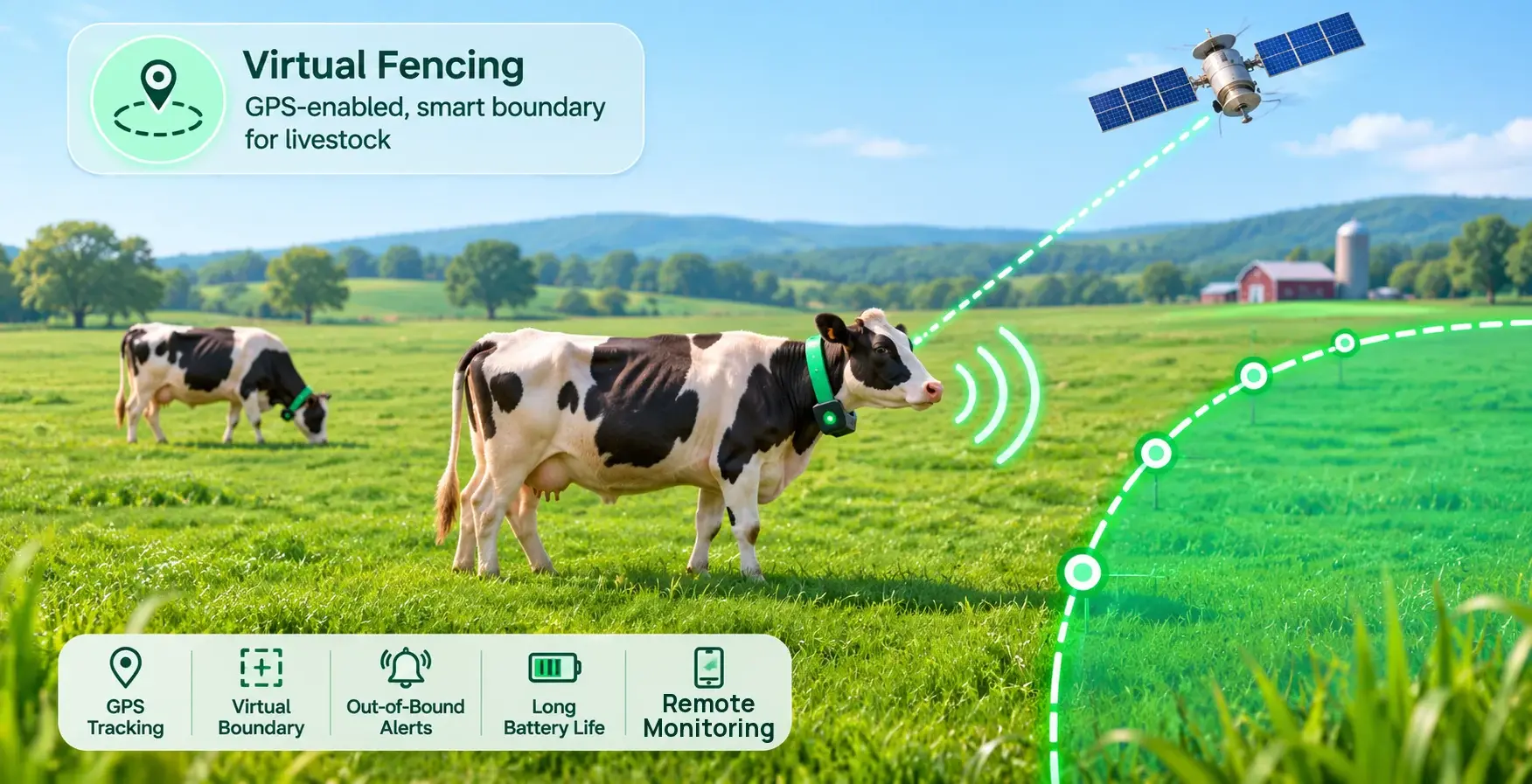
What a virtual fencing system is made of
Virtual fencing for livestock has three parts. Each animal wears a collar with a satellite positioning (GNSS) receiver, a small processor, a speaker or buzzer, a circuit that can deliver a brief, low-energy electrical pulse, and a battery — usually topped up by a small solar panel. A farmer draws the boundary in a web or phone app. And a communication link — cellular, LoRa or a dedicated base station, depending on the system — carries new boundaries down to the collars and status data back up.
The important design choice is where the decision is made. In well-designed systems the boundary is stored on the collar itself, and the collar checks its own position against it. US extension and conservation guidance (for example from NDSU and the USDA's NRCS) notes that this lets the fence keep working when the network drops out — which, on remote pasture, it regularly does. A design that waits for a server to say “you're too close” isn't a fence when the signal is gone.
How the collar knows where the boundary is
The geofence check
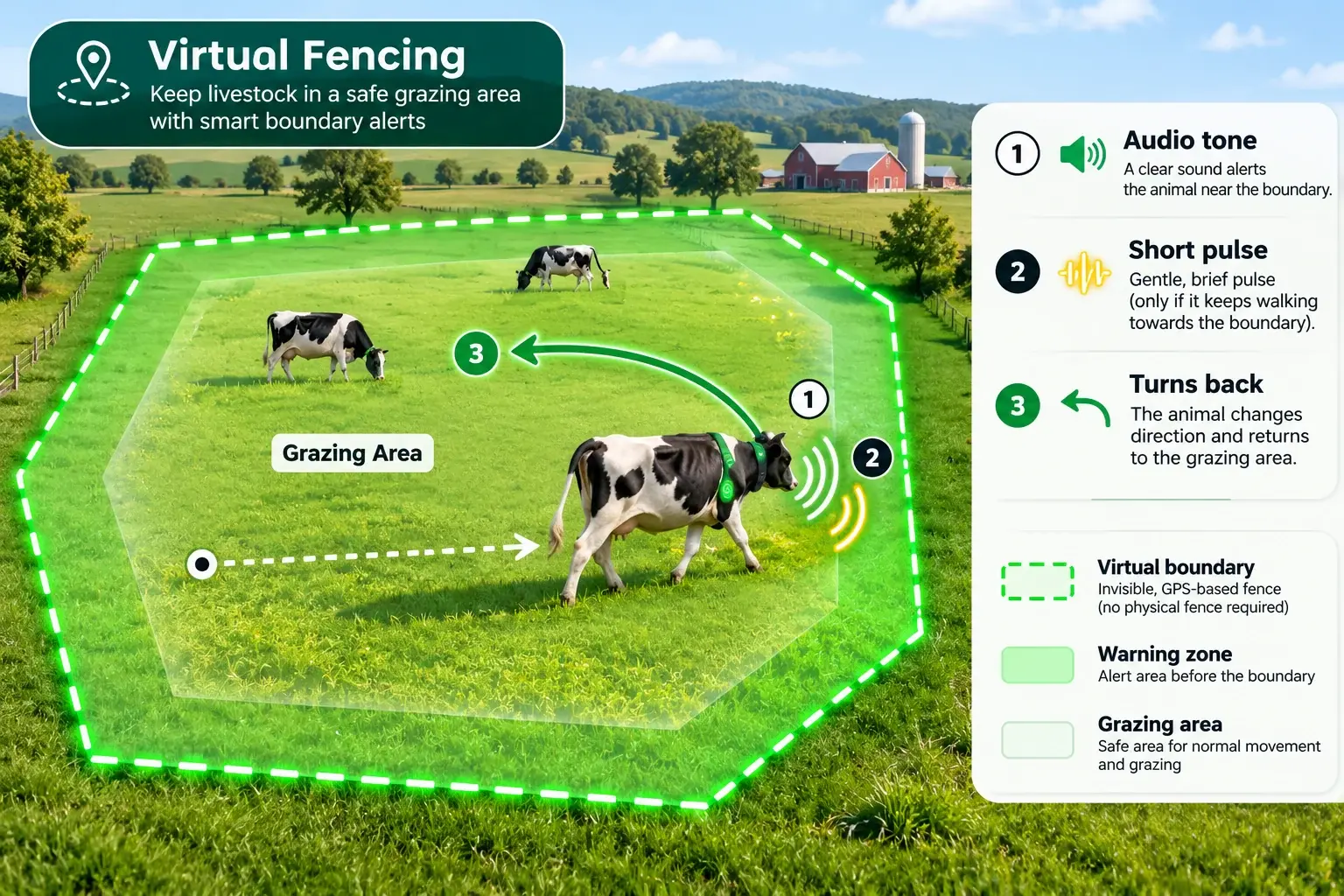
The boundary is stored as a polygon: a list of coordinates. Each time the collar gets a position fix, firmware runs a point-in-polygon test and calculates the distance to the nearest edge. That distance — not just “inside or outside” — drives everything else. Most systems define a warning zone just inside the line and use the animal's heading to tell whether it is approaching the boundary or walking along it. The maths is light enough for a low-power microcontroller; the hard part is trusting the position it is fed.
Living with GNSS error
A single-frequency GNSS receiver under open sky is typically accurate to a few metres. Under tree cover, beside steep slopes or close to buildings, errors grow and individual fixes can jump. Extension guides list tree cover and terrain as practical limits of virtual fencing for exactly this reason. On the collar, that means a raw fix should never trigger a cue on its own. Useful techniques include:
- Quality gating — discarding fixes with too few satellites or a poor reported accuracy estimate.
- Plausibility checks — rejecting a fix that implies the animal moved further than it physically could since the last one.
- Filtering — smoothing position and heading over several fixes, combined with accelerometer data that shows whether the animal is actually walking.
- A buffer — placing the warning zone far enough inside the boundary that normal GNSS error doesn't move it on top of the animal.
Antenna placement matters as much as firmware. The GNSS antenna needs to sit on top of the animal's neck with a clear view of the sky, which is why many collars use a counterweight underneath to stop the electronics from rotating out of position.
Sequencing the cues: sound first, pulse second
Published descriptions of commercial systems follow the same pattern. When an animal enters the warning zone, the collar plays an audio tone. If the animal turns back, nothing else happens. If it keeps walking towards the boundary, the collar delivers a short electrical pulse, and the cycle repeats until the animal responds. Animals learn to associate the sound with the pulse, and after a training period they respond to the sound alone — similar to how livestock learn to respect an electric fence.
From an engineering point of view, the cue logic is as much a welfare design as a control loop:
- Hard limits on pulse energy, pulse count and repetition, enforced in firmware and ideally also in hardware, so a software fault can't cause repeated stimulation.
- Fail-safe defaults. If position quality is poor or the battery is nearly flat, the safe behaviour is to stop cueing and report the problem, not to keep guessing.
- An audit trail. Logging every audio cue and every pulse with time and position lets the farmer — and, where required, an inspector — see how often animals are being corrected and whether a boundary is badly placed.
- An escape rule. An animal that has crossed the line should be guided back, not blocked from returning by cues on the wrong side.
Power: the constraint behind every other decision
Extension sources report collar battery life ranging from a few months to a full grazing season, depending on how often position is updated and how often cues fire. Those two numbers are the core of the power budget:
- GNSS fix rate. The receiver is usually the largest consumer. Updating every few seconds near the boundary and much less often deep inside the paddock — or while the accelerometer shows the animal is lying down — saves a large share of energy.
- Radio traffic. Sending every fix upstream is expensive. Sending summaries and events (cues, alarms, low battery) is usually enough.
- Cue energy. Audio and pulses are short, but a badly placed boundary that triggers cues all day can dominate consumption — another reason to log them.
- Solar input. A small panel helps in summer, much less in winter, at high latitudes or when the collar has rotated. The design has to survive the worst month, not the average one.
Choosing the communication link
Because the boundary lives on the collar, the radio link is for management, not real-time control: pushing new boundaries, reporting position summaries, cue counts and battery state. That changes the trade-off. Cellular LTE-M or NB-IoT works wherever there is coverage and needs no farm infrastructure. LoRaWAN needs a gateway on the farm but costs less energy per message and works where there is no cellular signal. Some systems use their own base station. Our guide to planning a LoRaWAN farm network covers the LoRaWAN side in more detail.
Mechanical design: a collar is a harsh place for electronics
Collars are rained on, rubbed against posts and troughs, covered in mud and exposed to frost and sun. The enclosure needs proper sealing (an IP rating that matches the real exposure, not just rain), strain relief for anything that flexes, and a strap and buckle that can't injure the animal or snag on vegetation. The electrode contacts for the pulse have to make reliable contact through hair without causing skin damage. These are not details to leave for the end of a project — they drive the shape of the PCB and the battery.
Regulation differs by country
Commercial virtual fencing systems are already used on farms in several countries, including the US and the UK. But the legal position of electrical-stimulus collars for livestock is not the same everywhere: for example, Sweden changed its rules to allow virtual fences for cattle, while in Germany and Austria such collars are currently not permitted for livestock under animal-welfare law. Anyone developing or deploying a system should check the current national rules for each target market before committing to a design — they can affect not only whether a product can be sold, but which features (pulse, audio only, logging) it needs.
What to decide before building a virtual fencing collar
- Species and animal size — cattle, sheep and goats need different collar sizes and cue levels.
- Required battery life and whether solar charging is realistic for your latitude and season.
- Connectivity on the target farms: cellular coverage, or a farm-owned LoRaWAN gateway.
- Paddock types: open pasture or tree cover and slopes that limit GNSS accuracy.
- Target markets and their animal-welfare rules.
- What data the farmer actually needs to see: positions, cue counts, alarms, battery state.
Each of these choices changes the hardware, so they are worth settling at the requirements stage rather than discovering them after the first prototype.
Frequently asked questions
Does a virtual fence replace perimeter fencing?
Usually not. Extension guidance generally recommends keeping a physical boundary fence along roads, neighbouring land and other high-risk edges, and using virtual fencing inside it — for rotational grazing, protecting sensitive areas such as streams or regrowth, or dividing large paddocks without building permanent fences. The physical perimeter is the safety net if a collar fails or an animal does not respond.
How long does it take animals to learn a virtual fence?
Published farmer and extension accounts describe a training period of days rather than weeks, but it varies with species, age, herd behaviour and how the training is run. A common approach is to introduce the virtual boundary next to an existing physical fence, so animals learn to link the audio cue with the boundary before the physical fence is removed. The cue log is the best way to see when animals have learned — corrections should drop off quickly.
What happens if a collar's battery runs out or it loses GNSS?
A well-designed collar fails safe: with an empty battery or unreliable position, it stops giving cues rather than guessing. That means the animal is no longer contained by that collar, which is why low-battery warnings well in advance, clear alarms for lost positioning, and a physical perimeter all matter. Battery state should be visible for every animal, not just as a herd average.
Does virtual fencing work for sheep and goats as well as cattle?
Some commercial systems are offered for sheep and goats as well as cattle. Smaller animals need lighter collars, different fitting, and cue levels adjusted to the species. Body size also affects how much room there is for a battery and solar panel, so battery-life targets are usually harder to reach for small ruminants than for cattle.
Working on a virtual fencing or livestock tracking product? Tell us about your project — collar electronics, GNSS and power design can be developed to your requirements. See also Virtual Fencing and Animal Tracking.