Ammonia, CO₂ and Humidity Sensors in Poultry Houses: Placement, Calibration and Drift
Published
Air-quality readings drive ventilation decisions in a poultry house or shed. But ammonia, CO₂ and humidity sensors all behave differently in dust, moisture and ammonia-laden air — and a sensor that has quietly drifted is worse than no sensor at all.
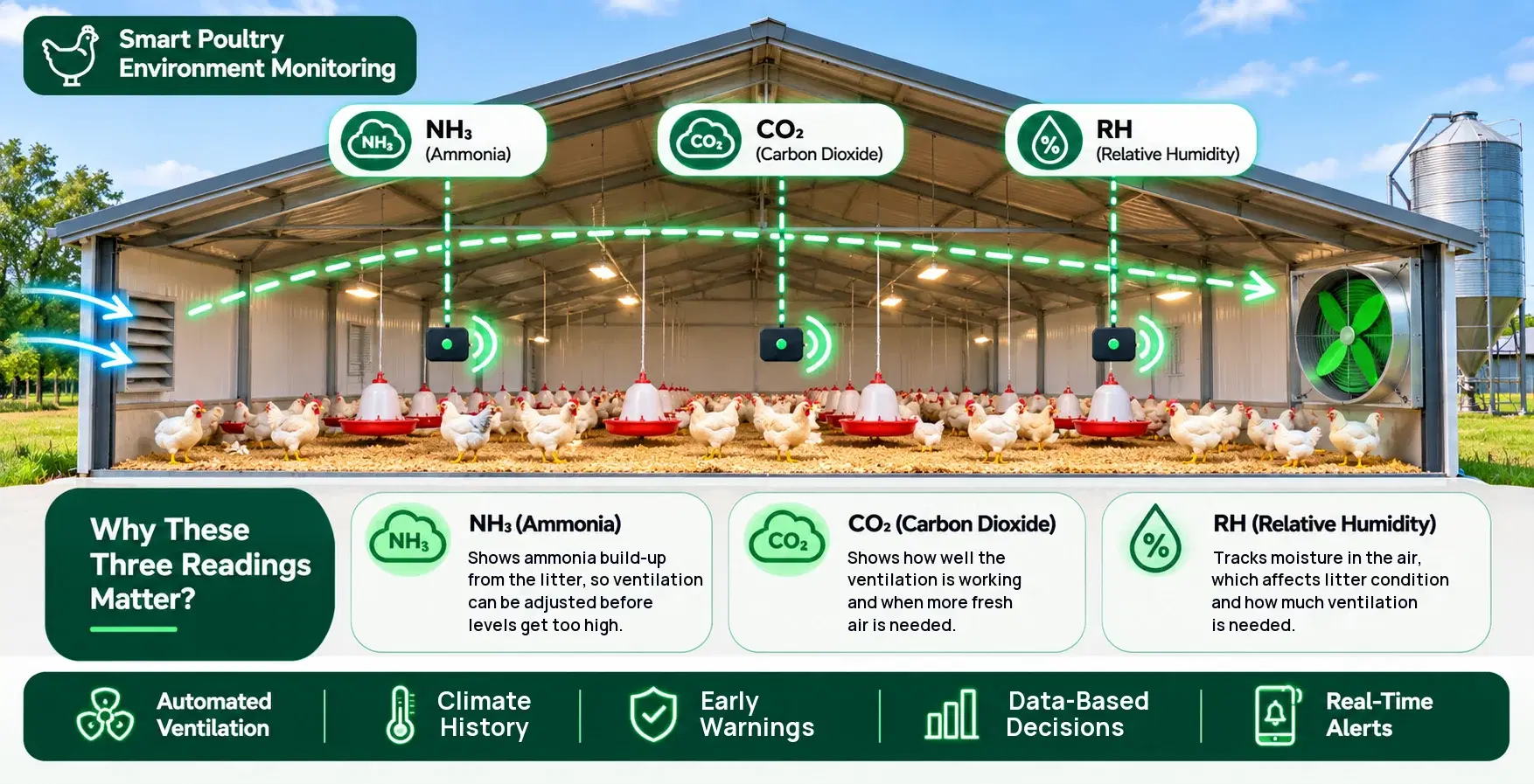
Why these three readings matter
Ammonia (NH₃) comes from litter and rises with litter moisture and poor air exchange. Carbon dioxide (CO₂) comes mainly from the birds and from gas-fired heaters, so it is a good indicator of how much fresh air is actually reaching the birds. Relative humidity links the two: wet air leads to wet litter, and wet litter releases more ammonia. Reading all three together tells you far more about ventilation than any one of them alone.
There is also a regulatory reason. For broilers kept at higher stocking densities, EU Directive 2007/43/EC — whose requirements also carried over into UK law — sets limits of 20 ppm ammonia and 3,000 ppm CO₂, measured at the level of the chickens' heads, along with limits on humidity in cold weather. Check the current national rules and any assurance-scheme requirements that apply to your farm, but the principle is clear: measurements need to represent what the birds breathe.
Ammonia sensors
Electrochemical vs. metal-oxide
Most professional ammonia sensors in livestock buildings are electrochemical cells: ammonia reacts at an electrode and produces a small current proportional to concentration. They are selective and accurate at low ppm levels, but they have a limited life — the electrolyte is consumed over time — and their sensitivity changes as they age. Manufacturers state a typical lifetime and a recommended calibration interval; both belong in the maintenance plan, not just the datasheet.
Metal-oxide (MOS) sensors are much cheaper and appear in many low-cost IoT projects. They respond to ammonia, but also to other gases, and their output depends strongly on temperature and humidity. They can show trends, but they are not a reliable basis for decisions against a 20 ppm limit without careful compensation and regular comparison with a reference instrument.
Checking that the reading is real
Because electrochemical cells lose sensitivity gradually, a sensor can keep producing plausible numbers while under-reading. A periodic bump test — exposing the sensor to a known gas concentration and confirming it responds — catches this. Comparing readings against a handheld reference meter at bird height is a practical alternative on farm. Either way, record the result: a calibration log is what turns a number on a screen into evidence.
CO₂ sensors and the auto-calibration trap
Most CO₂ sensors for this use are NDIR (non-dispersive infrared): they measure how much infrared light CO₂ absorbs. NDIR is stable and not consumed by the gas, which makes it a good fit for continuous monitoring.
The trap is automatic baseline calibration (ABC), enabled by default on many low-cost NDIR modules. ABC assumes the sensor sees fresh outdoor air — around 400 ppm — at some point every few days, and quietly resets its zero to the lowest value it has seen. That works in an office that empties at night. In a stocked poultry house, CO₂ never falls to outdoor levels, so ABC gradually shifts the zero upwards and the sensor under-reads. For livestock buildings, ABC should normally be disabled and the sensor calibrated manually, for example in fresh air between flocks.
Humidity and temperature sensors
Capacitive relative-humidity sensors are the standard choice: small, low-power and accurate when new. In a poultry house they face condensation, dust and ammonia exposure, all of which can shift readings over time. A protective filter cap (a sintered or membrane filter) keeps dust and splashes off the sensing element while letting air through. Sensors that support a heating cycle can drive off condensation. As with gas sensors, a periodic check against a reference instrument is the only way to know a humidity reading is still right.
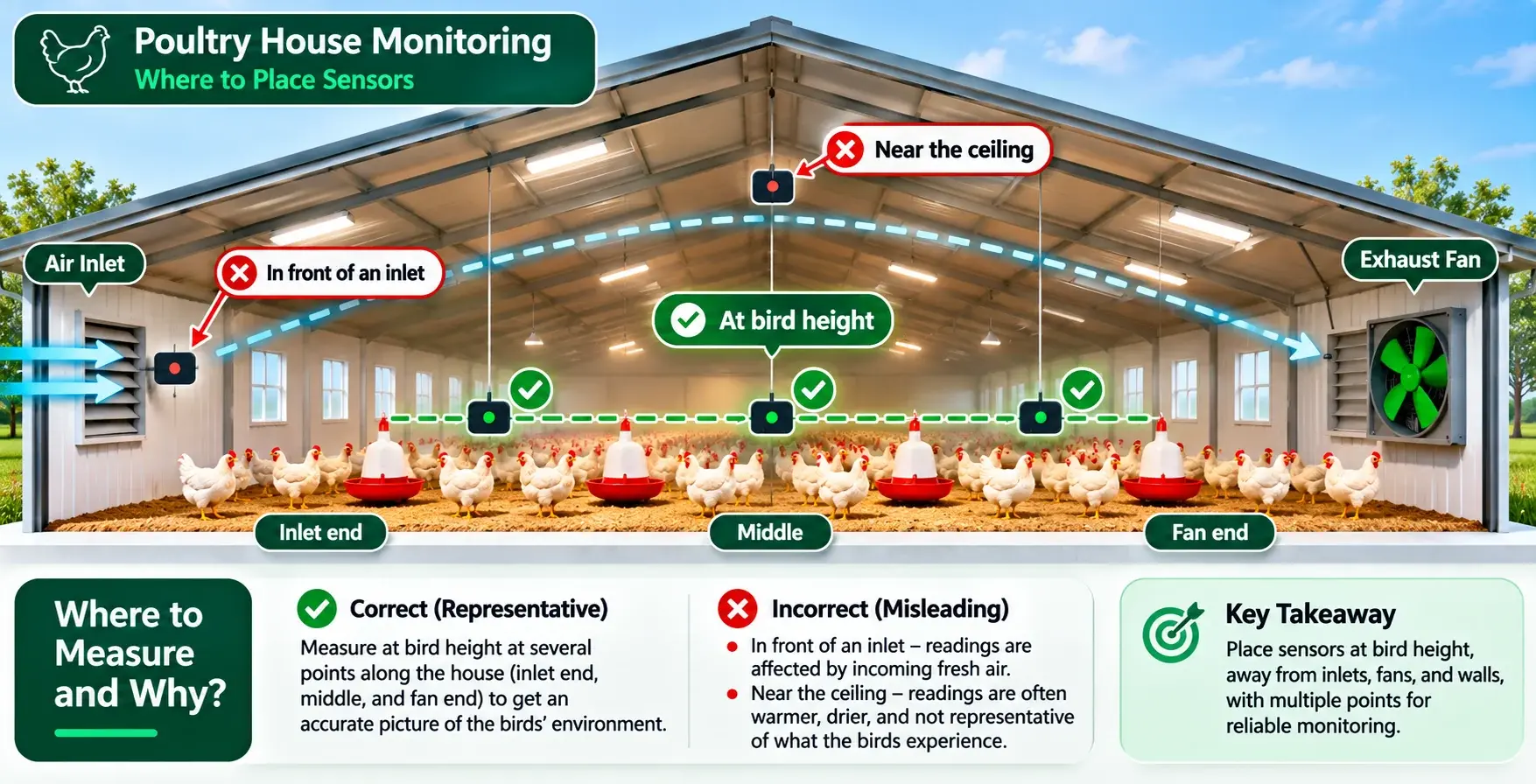
Placement: measure where the birds are
- Height. Mount sensors at bird height, not at ceiling height where they are easy to reach. Ammonia and temperature at the litter can differ a lot from conditions near the roof.
- Position along the house. Avoid placing sensors directly in front of inlets, fans or heaters. Conditions near the inlets and at the far end of a tunnel-ventilated house differ — larger houses need several measurement points.
- Protection. Birds peck at anything new. Sensors need guards, and cables need to be out of reach.
- Access. Someone has to check, clean and calibrate them. A sensor that needs a ladder and tools to reach will not be maintained.
Dust and washdown: designing for clean-out
Between flocks, houses are cleaned out, washed — often with pressure washers — and disinfected. A sensor that survives months of dust can fail in one washdown. Design options are to make the enclosure resistant to water jets and disinfectants (with an appropriate IP rating and compatible materials), or to make sensors quick to unplug and remove before cleaning. Removable sensor heads have another advantage: they can be calibrated or swapped on the bench while the house is empty.
From readings to decisions
Sensor data becomes useful when it is tied to action: adjusting minimum ventilation, checking for wet litter in one area, or investigating a heater. A few practical rules help:
- Log readings at a regular interval (every few minutes is typical) so trends are visible.
- Alert on sustained values, not single spikes caused by doors opening or a passing tractor.
- Flag sensors whose readings stop changing — a flat line often means a fault, not stable air.
- Keep the calibration history with the data, so readings can be trusted when they are reviewed.
Frequently asked questions
How often should ammonia sensors be calibrated?
Follow the manufacturer's stated interval as a minimum. In practice, a quick bump test or a comparison against a handheld reference meter between flocks — when the house is empty and accessible — catches most drift before it matters. Electrochemical cells also have a finite life, so plan replacements, not just calibrations.
What ammonia level is too high in a poultry house?
For broilers kept at higher stocking densities, EU Directive 2007/43/EC sets a limit of 20 ppm at the level of the birds' heads, and the same figure applies under UK rules derived from it. Many producers and advisers aim to stay well below the limit, because ammonia also affects bird health and worker comfort. Check the rules and assurance standards that apply to your own operation.
Can one set of sensors cover a whole house?
In a small house, possibly. In long, tunnel-ventilated houses, conditions at the inlet end and the fan end can differ significantly, so several measurement points give a far more accurate picture. Our article on wireless poultry monitoring networks covers multi-point layouts in more detail.
Wired or wireless sensors?
Both work. Wired sensors suit new builds or houses with an existing control backbone and avoid batteries entirely. Wireless sensors make retrofits and adding measurement points much easier. Either way, design for dust, ammonia and washdown, and make the sensors easy to reach for cleaning and calibration.
Designing sensor hardware for poultry houses? Get in touch — sensor nodes, enclosures and calibration features can be developed to your requirements. See also Poultry Farm Technology and Environmental Monitoring.