From Prototype to Production: The IoT Hardware Development Process
Published
A working prototype on the bench is an important milestone — but it is usually less than half of the way to a product that can be built in volume, certified and sold. This is what the remaining stages are for, and why skipping them tends to cost more than it saves.
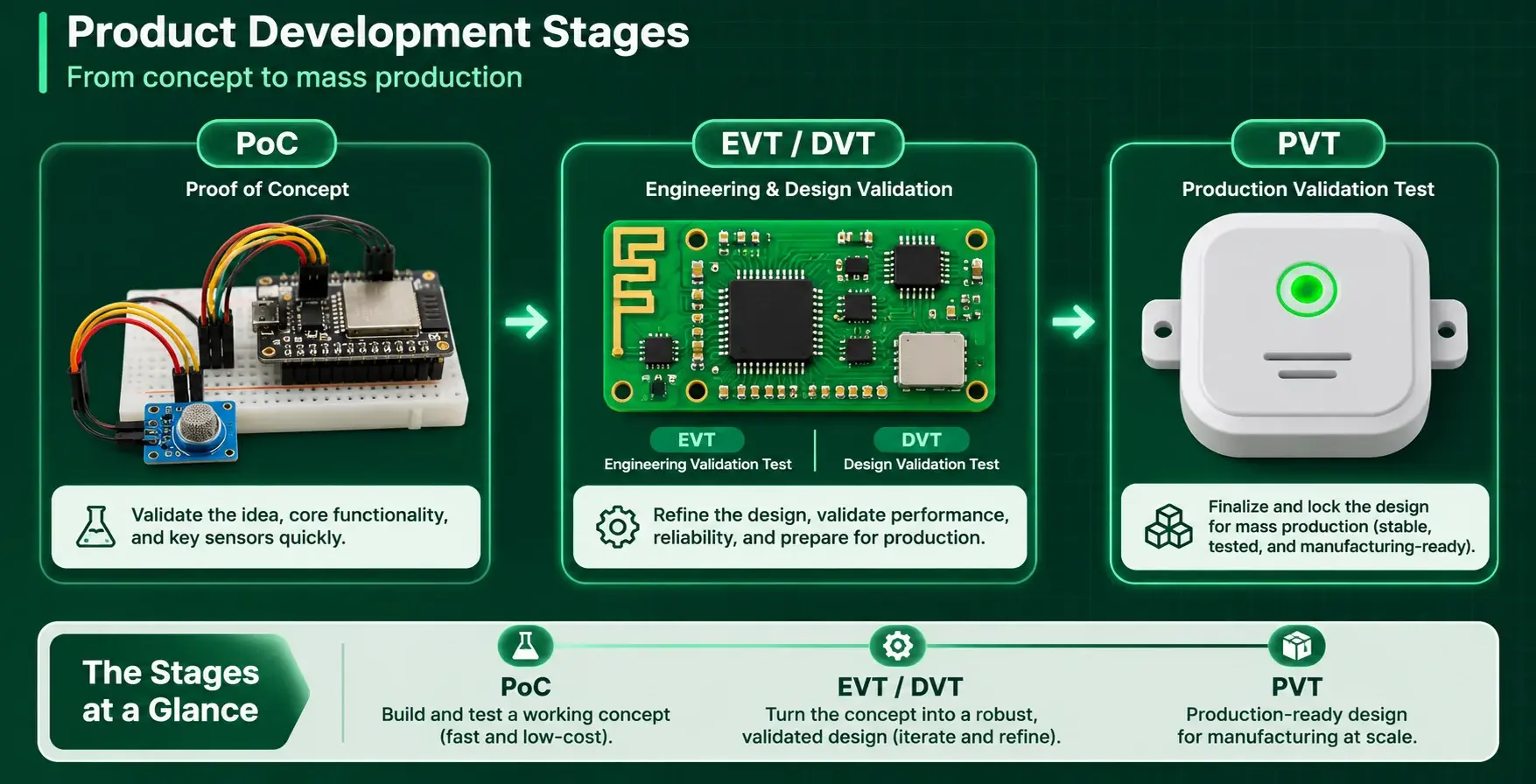
The stages at a glance
Hardware teams commonly describe electronics product development as a sequence of gated stages. Names and sample quantities vary between companies, but the logic is consistent: each stage answers a specific question before more money is committed.
- Requirements — what must the device do, where, for how long, and at what cost?
- Proof of concept — can the core technical risk be solved at all?
- Prototype — does a custom design work in a realistic form?
- EVT (engineering validation test) — does the design meet its functional requirements?
- DVT (design validation test) — does it survive testing and pass certification?
- PVT (production validation test) — can the factory build it reliably at volume?
- Mass production — ramp-up, with field feedback flowing back into the design.
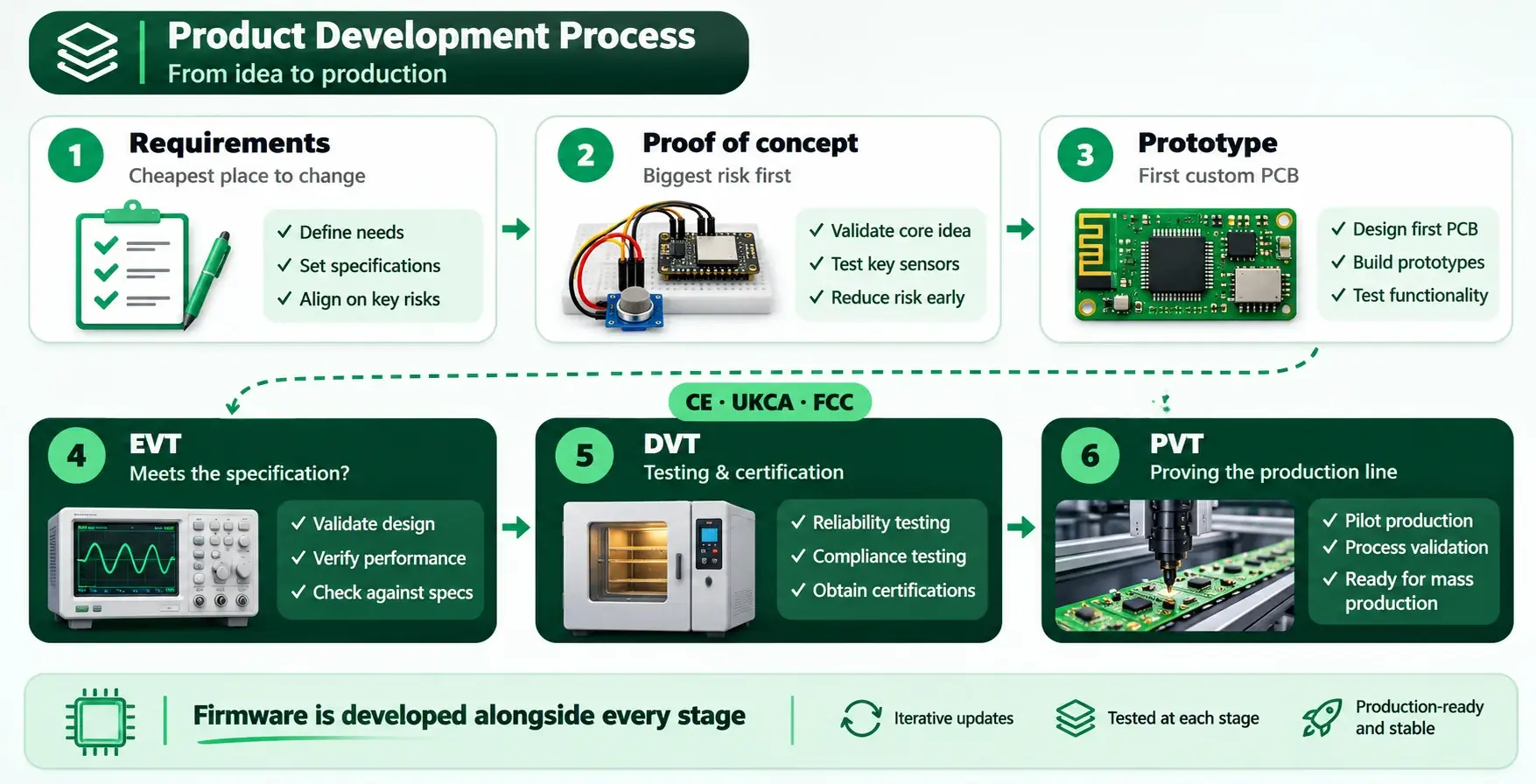
1. Requirements: the cheapest place to change your mind
Good requirements for an IoT device are specific and measurable: battery life at a stated reporting interval, operating temperature range, ingress protection, enclosure size and weight, target markets (which decides the certifications), connectivity available where the device will be used, and target unit cost at a realistic volume. Vague requirements such as “long battery life” or “rugged” are where projects later lose months. Every item on this list changes the hardware — so it is far cheaper to change it in a document than on a PCB.
2. Proof of concept: retire the biggest risk first
A proof of concept is usually built from development kits and evaluation boards. Its job is not to look like a product, but to answer the riskiest question early: will the radio reach from the field to the gateway? Can the sensor detect what it needs to? Is the power budget realistic? Keeping it narrow and fast is the point.
3. Prototype: the first custom PCB
The first custom board brings components, power supply, antenna and firmware together in something close to the final size. This is where problems that development kits hide appear: antenna performance inside an enclosure, sleep current that is ten times higher than expected because of one leaking circuit, or a connector that doesn't fit. Plan for at least one board revision.
4. EVT: does the design meet the specification?
EVT units are built with production-intent components and a near-final layout, typically in small quantities. Each requirement is tested and recorded: functions, power consumption in every operating mode, radio performance, sensor accuracy and firmware behaviour. Problems found here are still relatively cheap to fix. A common mistake is ordering expensive production tooling (such as injection moulds) at this stage, before the design has been validated.
5. DVT: environmental testing and certification
DVT units should be built using production-intent processes and materials, because they are the ones that go through environmental testing (temperature, humidity, vibration, drop, water and dust) and pre-compliance and certification testing. For connected devices, certification is often the biggest single source of delay, so it pays to plan it from the start.
Certification by target market
- European Union: CE marking. For products with a radio, the Radio Equipment Directive (2014/53/EU) applies, including cybersecurity requirements for many internet-connected radio products since August 2025. The EU Cyber Resilience Act adds further obligations for products with digital elements, with its main requirements applying from December 2027.
- United Kingdom: UKCA marking for Great Britain, with CE marking also accepted for many product categories — check current UK government guidance for your product type.
- United States: FCC authorisation under Part 15. Using a pre-certified radio module reduces the work significantly, but the finished product still needs its own testing for unintentional emissions, and cellular network operators may have their own device approval requirements.
- Batteries: lithium cells and battery packs need UN 38.3 test documentation to be shipped.
Choosing pre-certified radio modules, keeping the antenna design close to the module manufacturer's reference, and running pre-compliance scans before formal testing all reduce the risk of a failed test late in the project.
6. PVT: proving the production line
PVT is the first run on the real production line, with final tooling, test fixtures and processes. The question is no longer “does the design work?” but “does every unit work, and can we prove it?” That requires design for manufacture and design for test decisions made much earlier: test points on the PCB, a programming and calibration fixture, an end-of-line functional test, and a way to record each unit's serial number, firmware version and test result.
Firmware runs alongside the hardware stages
Firmware development doesn't wait for final hardware. It starts on development kits during the proof of concept and matures with each build. Two capabilities are worth designing in early for connected devices: secure over-the-air (OTA) updates, so field units can be fixed without a recall, and remote diagnostics — battery voltage, signal strength, reset reasons — so problems can be understood without retrieving the device.
Where IoT hardware projects usually go wrong
- Requirements that leave out the operating environment or target markets.
- Committing to production tooling before the design has passed validation.
- Treating certification as a final step instead of a design input.
- Measuring battery life on the bench, not in realistic radio and temperature conditions.
- No plan for testing units in production or updating them in the field.
Agriculture and animal devices: extra considerations
Devices for farms and animals add their own constraints: wide temperature swings, mud, water and ammonia; animals that chew, rub and kick; long distances to the nearest gateway; and users who need devices to work for a full season without attention. These belong in the requirements on day one — they shape the enclosure, the battery and the radio choice.
Frequently asked questions
How long does IoT hardware development take?
It depends on complexity, certification scope and how many board revisions are needed, so be wary of fixed promises. For a connected device with a custom PCB, radio and enclosure, the path from requirements to production commonly spans many months. Certification testing, enclosure tooling and component lead times are often the longest items — which is why they should be planned from the start, not at the end.
What drives the cost of developing a connected device?
The main drivers are the number of distinct functions and sensors, the radio technologies involved, the target markets (each adds certification work), environmental requirements such as waterproofing, the enclosure and its tooling, and the production volume. Clear requirements reduce cost more reliably than anything else, because they reduce redesigns.
Can a development board or module go straight into the product?
For very small volumes or pilots, a ready-made module or system-on-module can be a sensible shortcut. For volume production, a custom PCB is usually smaller, cheaper per unit and better suited to the enclosure, battery and antenna. Many products combine the two: a pre-certified radio module on a custom carrier board.
If the radio module is certified, does the product still need testing?
Yes. A pre-certified module simplifies the radio part of compliance, but the finished product still has to meet the applicable requirements as a whole — for example EMC, safety and, in the EU, the Radio Equipment Directive as applied to the complete device. The module's certification is a head start, not a substitute.
Planning a connected device and want to get the early stages right? Start a conversation — requirements, PCB design, firmware and prototypes can be developed per project. See also Custom Electronics and How We Work.